
MIT Open Documentary Lab Fall 2025 Newsletter

Happy Indigenous Peoples’ Day!
As we embark on the fall semester at the MIT Open Documentary Lab and the Co-Creation Studio, we eagerly anticipate the growth and energy it brings. Not only do we have five new fellows joining our community, but also four graduate students from MIT’s Department of Urban Studies and Planning (DUSP), which is our new home. They bring so much energy, passion, curiosity, and knowledge.
We are thrilled to join DUSP under the leadership of Professor Ceasar McDowell. In DUSP, our focus will still be documentary and emerging technologies, but we will also have the opportunity to further explore the relationship between narrative and place through projects such as Worlding and Layers of Place.
We have a lot in the pipeline this fall, ranging from a newly expanded AI and Documentary Working Group to a new research project exploring public libraries as sites of distribution, exhibition and access to Extended Reality (XR) experiences and tools. We continue to address the world’s most pressing problems from climate to independent and public fact-based media ecosystems with new documentary forms and co-creative practices. In the words of the late Jane Goodall, “You cannot get through a single day without having an impact on the world around you. What you do makes a difference, and you have to decide what kind of difference you want to make.”
New 2025 - 2026 Open Documentary Lab Fellows
We are thrilled to welcome five new fellows this semester by way of our partnerships with Onassis ONX Studio, Royal Shakespeare Company and through our Co-Creation Studio. They represent a range of disciplines including documentary, theater, games and art.

May Abdalla, an Onassis ONX Fellow, is a twice Emmy-nominated director and artist recognized for her groundbreaking work that merges physical experience, technology, and storytelling. Her projects offer poetic insight, tackling contemporary issues through a mixture of documentary, game-design and speculative fiction. She co-founded the award-winning studio Anagram in the UK in 2013 to experiment with modes of user interactivity in non-fiction storytelling. Anagram’s Playing With Reality has received two Venice Lions the Grand Jury Award for Best VR and the Immersive Achievement Award in 2024. At MIT Open Doc Lab, she will work on Amorphous, a transformative multiplayer experience that redefines how we inhabit our bodies.

Asha Easton, a Royal Shakespeare Company Fellow, is a lead on Innovate UK’s Immersive Tech Network, helping guide organisations in the XR sector looking for funding for developing innovative products related to XR. She shares insights into the market and uses her network to help organisations create powerful connections. She supports organisations involved in Virtual Reality, Augmented Reality, Mixed Reality, Film/TV, Production & post-production, VFX & Animation, Gaming, 5G, Hardware and Wearables. She is passionate about helping to promote diversity & inclusion in the XR space and is a co-founder of the XR Diversity Initiative, involved in working groups for XRAccess, and a member of Women in Immersive Tech. At MIT Open Doc Lab, she will research business models, sustainability and longevity in the XR industry.

Navid Khonsari, an MIT Co-Creation Studio Fellow, is a co-founder of iNK Stories. Khonsari helped shape the cinematic style of Grand Theft Auto, Max Payne, and Resident Evil, and has pioneered award-winning titles like 1979 Revolution: Black Friday and HERO. His latest project, Lili—a hybrid screenlife video game + live-action film now in production—uses AI on multiple fronts to push the boundaries of interactive storytelling. After premiering at Cannes as the first video game in competition, Lili continues to redefine how technology, cinema, and games collide. His research investigates how artificial intelligence can be reimagined as a collaborator and co-author in storytelling, shifting the boundaries of authorship, agency, and ethics in narrative creation.

Pei-Ying Lin, a Royal Shakespeare Company Fellow, is an artist/designer from Taiwan and is currently based in Eindhoven, the Netherlands. She holds a MA in Design Interactions from the Royal College of Art, UK and a BSc in Life Science from National Tsing Hua University, Taiwan. She will investigate how we perceive and classify AI, as well as observe how researchers attune their bodies and senses to protocols, and how they interpret invisible entities (like microorganisms) through indirect observation.

Neda Moridpour (she/they), a Royal Shakespeare Company Fellow, is a Kurdish-Iranian cultural futurist, artist, and organizer whose research examines cycles of violence that lead to displacement, discrimination, and systemic inequities. Through socially engaged art and community-based participatory research, they create collaborative spaces grounded in mutual care, community building, and the visualization of future world-building. Moridpour is a Professor of the Practice at the SMFA and Tisch College at Tufts University. Their fellowship will focus on an interactive and multi-platform art project, initiated by Hamdel Futurist Collaborative, which reimagins the archive not as a static repository, but as a living, participatory space of collective care, solidarity, and shared memory.
These five fellows will be in fellowship with our four returning fellows. You can learn more about them here!
Invite to Join Monthly AI+Documentary Working Group
The AI + Documentary Working Group is part of a joint initiative between Co-Creation Studio at MIT Open Doc Lab and WITNESS, a Human Rights Media Organization. Since 2018, we have been exploring the intersections between AI and Documentary / Non-Fiction, through research, publications, speaker series, presentations and advocacy, including submissions to the UN. We critically engage with technologists, documentarians, artists, policy makers, human right advocates and communities around the world to actively examine how AI is changing documentary practice, how AI affects creative integrity, the spread of misinformation, satire, and freedom of expression, and how documentarians can ethically engage with and cover the AI industrial complex.
This academic year, the Working Group is opening up monthly meetings to a wider informal membership. The meetings will include speakers, presentations, discussion groups, as well as developing open-sourced resources featuring a database with relevant readings, films, media projects, tools and organizations.
The 2025 meetings will take place on zoom on:
Tuesday October 28, 2-3:30 pm ET
Tuesday November 25, 2-3:30 pm ET
Tuesday December 9, 2-3:30 pm ET
With more dates to come in 2026.
Some questions we will explore together could include:
In what ways can documentary practices adapt to the challenges posed by AI, such as deepfakes, personalized and automated content generation, while maintaining and protecting journalistic integrity, public trust and human rights?
How can documentarians verify and contextualize AI-generated content without undermining creativity or freedom of expression?
How can documentary filmmakers ensure the authenticity and originality of their work in an era where AI-generated content is prevalent? And what are the ethical and practical strategies to mitigate AI slop in documentary and satirical media?
We are hoping you can share this invite with your community, and that you might join us! Again, please RSVP here, and you will receive zoom links to the meetings as well as occasional news from us.
Working Group co-leads,
Katerina Cizek, Co-Creation Studio
shirin anlen, WITNESS
Tabitha Jackson, ODL Fellow
Navid Khonsari, ODL Fellow


The Synthesis: A Monthly Column in Documentary Magazine
The Synthesis continues to do important work that dives into the intersection of Artificial Intelligence and documentary practice. Co-authors Kat Cizek and shirin anlen synthesize the latest intelligence on synthetic media and AI tools—alongside their implications for nonfiction mediamaking. The Synthesis is part of an ongoing collaboration between the Co-Creation Studio at MIT’s Open Doc Lab and WITNESS.
Read the latest from our monthly column: an interview with Raoul Peck reflecting on deploying AI-generated imagery to illuminate Orwell’s insights about linguistic manipulation:
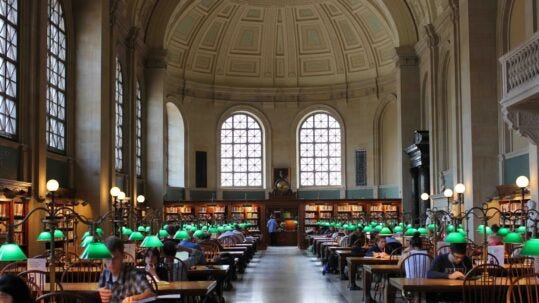
Libraries as hubs for XR distribution, exhibition and creation
As longstanding centers for knowledge exchange, civic engagement, and public access to knowledge, libraries offer a unique infrastructure for fostering immersive storytelling outside of corporate pipelines. Libraries are everywhere—from small rural towns to big cities, on the coasts and in the prairies of middle America. They are open to all and an important equalizer of knowledge. They have deep roots in their communities with long-term relationships with community centers and schools.
We are collaborating with Cambridge Public Library, LA Public Library as well as Stanford Public library to explore the potential role of libraries in commissioning, distributing, and expanding access to immersive experiences.
This initiative is funded by Agog: The Immersive Media Institute.
Warm regards,
MIT Open Documentary Lab and Co-Creation Studio
With generous support from:
